
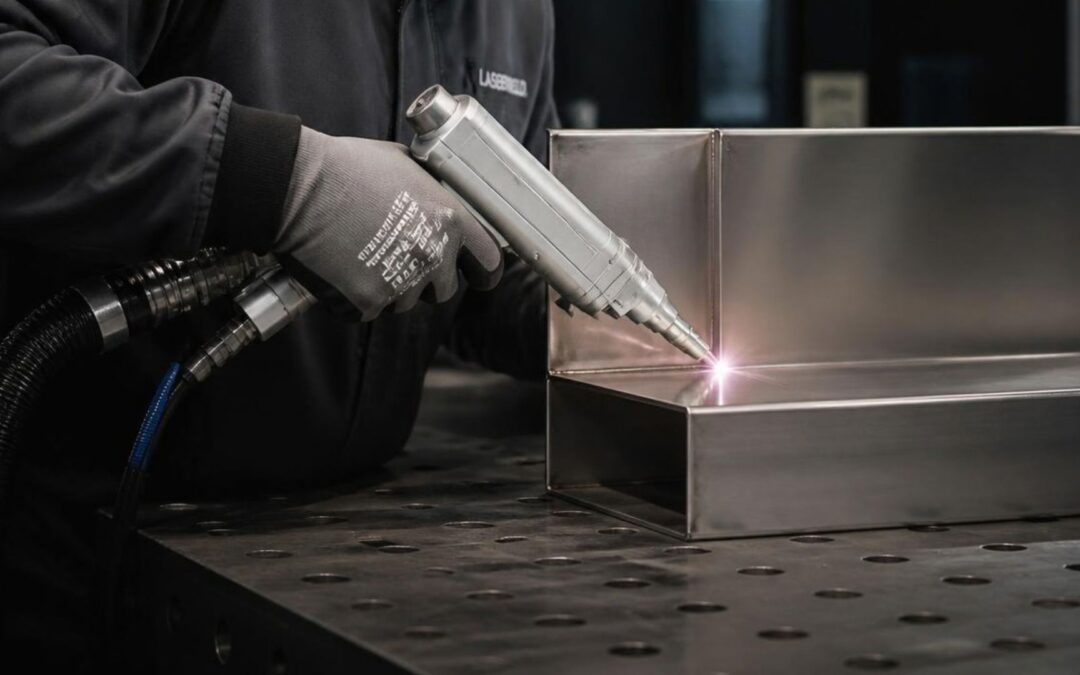
Handheld laser welders have moved from a novelty to a genuine shop-floor option over the past few years, but that doesn’t mean TIG and MIG are obsolete. Each process trades off speed, finish quality, operator skill, and cost differently, and the right choice usually comes down to what you’re welding and how much of it you’re doing, not which machine is newest.
How Each Process Works
- TIG (GTAW) — a tungsten electrode creates the arc while filler metal is fed in separately by hand, shielded by inert gas. It gives the operator the most control of the three processes, at the slowest travel speed.
- MIG (GMAW) — a continuous wire electrode feeds automatically through the torch, acting as both arc source and filler. It’s faster than TIG but generally produces more spatter and a rougher finish.
- Handheld laser welding — a focused laser beam melts the joint, often assisted by a wire feed, guided by hand across the seam. The concentrated heat source is what gives it a narrow heat-affected zone compared with either arc process.
Speed: Where Laser Welding Pulls Ahead
Handheld laser welding can achieve higher travel speeds than TIG in many thin-to-medium material applications. However, the actual speed advantage depends on material type, thickness, joint design, welding settings, operator experience, and quality requirements. MIG is generally faster than TIG, and how it compares with laser welding varies with the application. For shops running long weld seams or high part counts, any speed advantage can add up quickly across a production day.
Heat Input, Distortion and Finish
Laser welding generally puts the least heat into the part of the three processes, which means less warping on thin sheet and a weld that often needs little to no post-weld grinding, particularly on stainless where discolouration and heat marks are a common quality complaint. TIG is the cleanest of the two arc processes but still carries meaningfully more heat input than laser, and some distortion on thin material is normal. MIG welding can produce higher heat input and more spatter than TIG or laser welding in many applications, depending on the material, settings, and welding technique, which can mean more post-weld cleanup time.
Operator Skill and Learning Curve
TIG has the steepest learning curve of the three — coordinating torch angle, filler feed, and foot pedal current control well takes real time to master. MIG is comparatively forgiving and is often the first process a new welder learns. In terms of the time required for an operator to produce a clean weld, handheld laser welding may be more comparable to MIG than to TIG in some applications, since the laser handles much of the melt pool control, though operators still need proper training on beam handling, fixturing, and laser safety before running one unsupervised. Hasil Karya’s services team covers this training as part of a machine purchase.
Cost: Machine Price vs Cost per Weld
Although a handheld laser welding machine typically has a higher upfront cost than a TIG or MIG setup, the evaluation should not be based on the purchase price alone. At volume, the combination of higher travel speed and reduced post-weld grinding and cleanup labour can bring the true cost per weld below a comparable arc process, even after accounting for the higher machine cost. For low-volume, prototype, or highly custom work, the lower upfront investment of TIG or MIG is often still the more sensible choice.
When comparing the true cost per weld, it helps to look at every cost factor rather than the machine price alone:
- Machine purchase price
- Consumables
- Labour
- Welding speed
- Post-weld grinding
- Maintenance
- Operator training
- Safety equipment
- Production volume
This is why the most expensive machine is not necessarily the most cost-effective option for every business.
Which Process Fits Your Shop
High-mix, low-volume precision work — thin stainless, visible cosmetic welds, tight-tolerance assemblies — tends to favour handheld laser welding. Structural work, thick-section material, and field welding away from the shop still generally favour MIG or TIG. Most shops that add laser welding keep their existing TIG and MIG equipment running rather than replacing it outright, using each process where it’s genuinely the better tool.
For example, a workshop producing stainless-steel cabinets or visible decorative components may prioritise a clean finish and reduced post-weld grinding. By contrast, a workshop carrying out structural repairs or outdoor field welding may place greater importance on equipment flexibility and portability.
Explore Hasil Karya’s Handheld Laser Welding Machine
Enquire for machinery in Malaysia!

QUICK LINK
PRODUCTS
LEGALS

CONTACTS
Copyright © 1983-2024 Hasil Karya Sdn Bhd 198301010332 (105695-V) – Your Trusted Industrial Steel Fabrication Machinery Solution Provider. All Rights Reserved.