
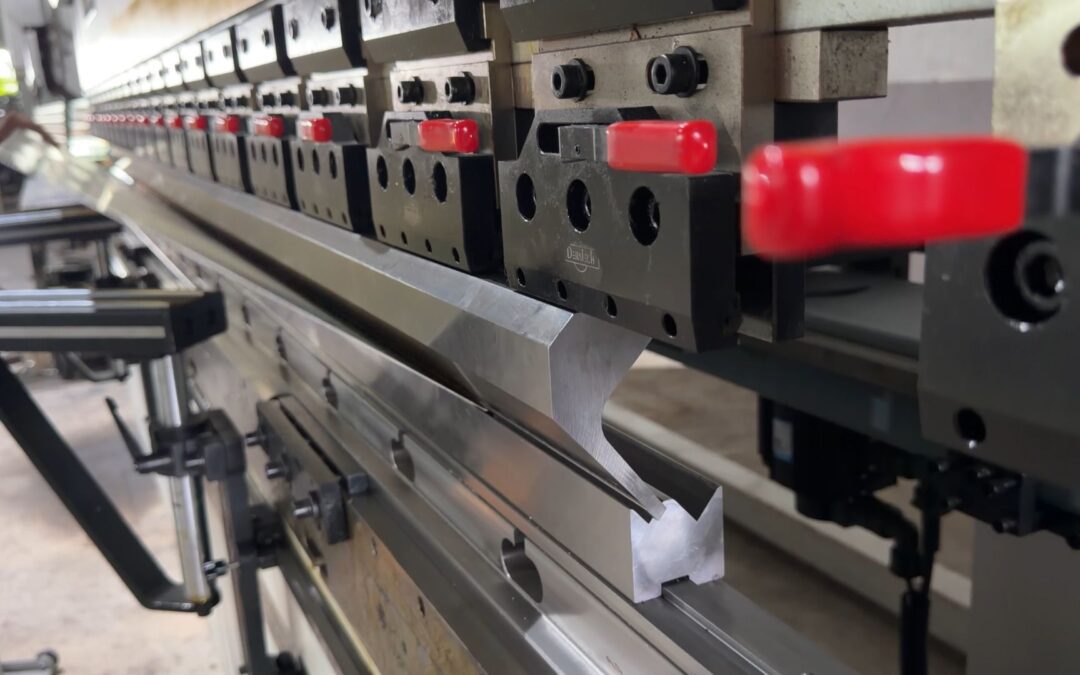
A press brake is one of the few machines in a fabrication shop that touches almost every job, bending sheet and plate to spec after it’s been cut. Choosing the right one comes down to three specifications that matter far more than any brand name: tonnage, bed length, and tooling. If you get any of these specifications wrong, the machine may be unable to handle your work or may cost more than necessary.
What a Press Brake Actually Does
A press brake forms a bend by pressing sheet or plate metal between a punch and a die to a set angle. It sits alongside cutting and folding as one of the backbone processes of sheet metal fabrication, and the part usually arrives at the brake already cut to size and profile by a laser or punching operation.
Tonnage: Matching Force to Material and Bend Length
Tonnage is the amount of force the machine can apply, and the tonnage a job needs depends on material thickness, material grade and tensile strength, bend length, and the die’s V-opening — thicker material and longer bends both push the required tonnage up quickly. Undersizing a press brake for your typical work overworks the machine and shortens its service life, while oversizing means paying for capacity you rarely use. Rather than estimating, it’s worth having your supplier calculate the exact tonnage from your material specification and typical die selection before you commit to a model.
Bed Length: Sizing for Your Largest Sheet
Bed length should comfortably exceed the longest bend you produce on a regular basis, with some allowance for future jobs rather than just what’s on the shop floor today. Choosing a machine based only on your current largest job can lead to capacity limitations. In some cases, a slightly longer bed could allow the workshop to complete the work in-house instead of outsourcing it.
Tooling: Punches, Dies and Segmented Sets
Standard tooling covers straightforward bends, while precision-ground tooling holds tighter angle tolerances for parts that need to match consistently across a production run. Segmented tooling — shorter punch and die sections that can be arranged in different combinations — makes box and pan bending possible without changing out the full tool set. The die’s V-opening also interacts directly with tonnage requirement and the minimum inside bend radius you can achieve, so tooling and tonnage really need to be selected together, not one after the other.
Back Gauge and Control System
A CNC back gauge with multi-axis positioning speeds up repeat jobs significantly and reduces operator-dependent variation between parts, compared to a manual back gauge that has to be reset by hand for every bend sequence. If your team is new to programming a CNC back gauge, Hasil Karya’s services team provides on-site setup support and operator training as part of a machine purchase.
New vs Used Press Brake
A used press brake can be a sound option for lower-volume shops or tighter budgets, but it’s worth having ram parallelism, back gauge wear, and hydraulic condition inspected before purchase. These components are particularly susceptible to wear and can be expensive to repair or replace if maintenance is neglected.
How a Press Brake Fits Into the Wider Fabrication Line
A press brake rarely works alone — most parts are cut on a laser or CNC punching machine first, then bent. Our guide to laser cutting and bending technology looks at how these two processes work together in-house. For tube and profile work rather than flat sheet, a pipe bending machine or CNC folding machine may be a better fit than a conventional press brake.
View Hasil Karya’s Press Brake Machine Range
Enquire for machinery in Malaysia!

QUICK LINK
PRODUCTS
LEGALS

CONTACTS
Copyright © 1983-2024 Hasil Karya Sdn Bhd 198301010332 (105695-V) – Your Trusted Industrial Steel Fabrication Machinery Solution Provider. All Rights Reserved.