
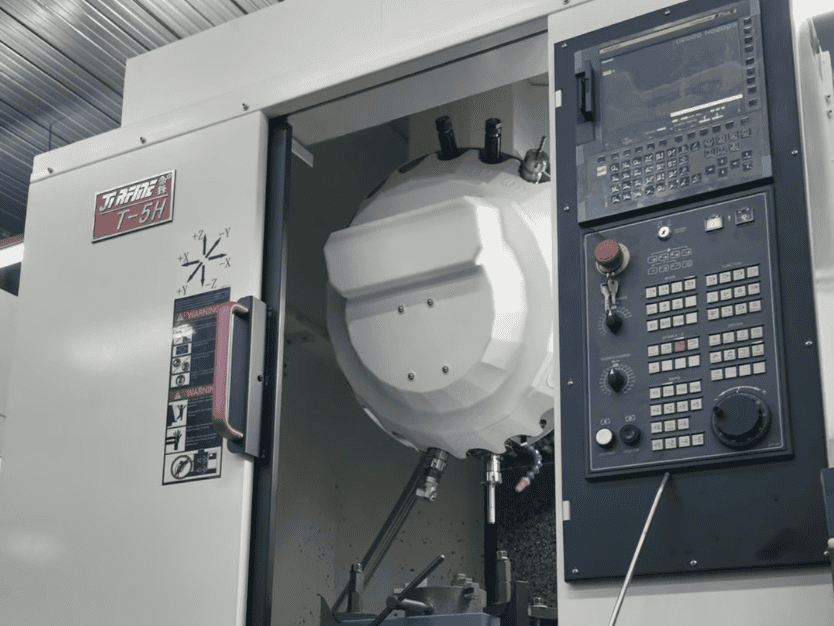
In semiconductor equipment manufacturing, “close enough” does not exist. Whether you are machining vacuum chamber lids, wafer chucks or sensor mounting plates, an error thinner than a human hair can cause a vacuum leak or throw a delicate chip-handling robot off target.
This guide explains what micron-level specifications actually mean on the shop floor, how modern milling machines hold them, and what to look for when you are choosing a CNC milling machine for precision work. Start with this quick guide:
| What the part needs | What it means | What helps the machine hold it |
|---|---|---|
| Tight dimensional tolerances | Dimensions held within a few microns so bolt patterns, alignment pins and mating housings fit without forcing | Rigid frame and precision linear roller guideways |
| Ultra-flat sealing surfaces | A surface that stays level from one corner to the other, so O-rings and metal seals lock airtight under high vacuum | Heavy, vibration-damped machine bed |
| Steady dimensions all day | Parts measure the same in the morning and the evening | Continuous oil or water cooling around the spindle |
What Is a Micron, and Why Does It Matter?
A micron is one thousandth of a millimetre. A human hair is typically several dozen microns thick, so a tolerance of a few microns is far finer than anything you can see or feel. In semiconductor parts, that level of control is what lets components fit, seal and move exactly as designed.
What Micron-Level Specs Actually Mean on the Shop Floor
- Tight dimensional tolerances: holding dimensions within a few microns ensures bolt patterns, alignment pins and mating housings fit together seamlessly, without forcing or bending parts.
- Ultra-flat sealing surfaces: flatness measures how level a surface stays from one corner to the other. Semiconductor plates need mirror-flat faces so rubber O-rings and metal seals lock airtight under high vacuum.
How Modern Milling Achieves Micron-Level Accuracy
- Thermal stability and spindle cooling: continuous oil or water cooling around the spindle prevents heat buildup from expanding machine parts mid-cycle, keeping dimensions steady from morning to evening.
- Rigid frames and precision linear roller guideways: a heavy, vibration-damped machine bed paired with smooth linear roller guideways prevents tool chatter, leaving flat, mirror-smooth surfaces right off the machine.
What to Check Before You Buy
- Does the machine have spindle cooling, and is it designed for long, continuous cycles?
- Is the frame heavy and vibration-damped, with linear roller guideways on the axes?
- What are the stated positional accuracy and repeatability? Our guide to positional accuracy vs repeatability explains how to read these numbers.
- Is the machine suited to the part geometry? See 3-axis vs 5-axis milling for how setups affect accuracy.
- Will your workshop keep a reasonably stable temperature? Even a well-built machine performs best in a stable environment.
Conclusion
Micron-level precision is not a single feature. It comes from stable temperatures, a rigid structure and smooth motion working together. For semiconductor parts, where one leaking seal or misaligned plate can stop a whole tool, those details are worth checking before you commit to a machine.
Need help matching a machine to your precision parts? Visit us at Jalan Perusahaan Utama, Taman Industri Selesa Jaya, Balakong, Selangor, or reach the team through our Contact Us page.
Frequently Asked Questions
What does “micron-level” tolerance mean?
It means dimensions are controlled to within a few thousandths of a millimetre. This level of control is common in semiconductor equipment parts such as vacuum chamber lids and wafer chucks.
Why does flatness matter for vacuum chamber parts?
Seals only work when mating surfaces are extremely flat. A surface that is even slightly uneven can let air leak in under high vacuum.
How does spindle cooling help accuracy?
Heat makes metal expand. Oil or water cooling around the spindle keeps temperatures steady, so dimensions stay consistent from the first part of the day to the last.
Why are linear roller guideways important?
They give smooth, rigid axis movement that reduces vibration and tool chatter, which helps produce flat, mirror-smooth surfaces.
Which CNC machine suits precision semiconductor parts?
Look for a rigid, vibration-damped machine with spindle cooling and linear roller guideways, then check its accuracy and repeatability figures. Our team can help you match a machine to your parts.