
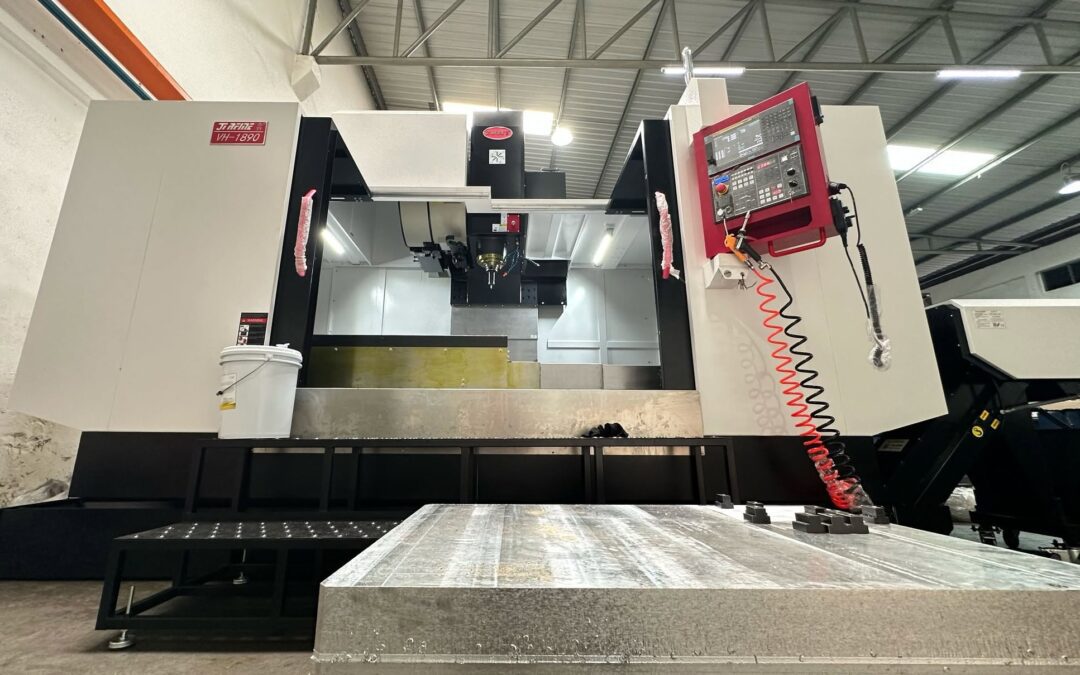
When you are expanding workshop capacity, one of the biggest decisions is choosing between a Vertical Machining Center (VMC) and a Horizontal Machining Center (HMC). Both cut metal with high precision, but the spindle orientation changes how each one performs on the shop floor.
This guide compares the two side by side so you can decide which one fits your parts, your volumes and your budget. If you are still learning the basics, start with our overview of the types of CNC milling machines. Here is the quick comparison:
| Feature | Vertical (VMC) | Horizontal (HMC) |
|---|---|---|
| Spindle direction | Points straight down at the table | Points sideways towards a multi-sided workholding pallet |
| Chip evacuation | Chips collect on the parts; requires air or coolant blasts | Gravity wins: chips fall straight down into the conveyor |
| Best production style | High-mix, low-volume jobs, prototypes and flat plates | Medium-to-high volume runs and multi-side box parts |
| Footprint and cost | Compact footprint and lower initial investment | Larger footprint, built for continuous, high-output runs |
Why Chip Evacuation Matters
Chips left on the part can be re-cut, scratch surfaces and shorten tool life. On a VMC, chips tend to collect on the workpiece, so operators rely on air or coolant blasts to clear them. On an HMC, the sideways spindle lets gravity drop chips into the conveyor, which supports longer unattended runs.
When a VMC Makes Sense
- You run many different jobs in small batches, or build prototypes.
- Your parts are mostly flat plates or need machining on one or two sides.
- You want easy operator visibility and fast job changeovers.
- Floor space and initial investment are limited.
When an HMC Pays for Itself
- You run repetitive, multi-sided parts such as valve bodies, pump housings or gearboxes.
- You want built-in dual-pallet changing, where one table loads outside while the other cuts inside.
- You want to clamp several parts at once, often with a multi-hole fixture column, for non-stop output.
- You produce medium-to-high volumes and need continuous output.
Questions to Ask Before You Buy
- What are my most common parts, and how many sides need machining?
- What batch sizes do I run, and are they likely to grow?
- How much floor space and budget do I have?
- Do I need pallet changing or a multi-part fixture setup?
Conclusion
If you want versatility, easy operator visibility and fast job changeovers, a VMC is your everyday workhorse. If you run repetitive multi-sided parts and want non-stop output, an HMC quickly pays for itself. Whichever you choose, check how the machine handles your most common part first, and read about 3-axis vs 5-axis milling if your parts need more than one or two sides machined.
Not sure which machine suits your parts and volumes? Visit us at Jalan Perusahaan Utama, Taman Industri Selesa Jaya, Balakong, Selangor, or reach the team through our Contact Us page.
Frequently Asked Questions
What is the main difference between a VMC and an HMC?
The spindle direction. A VMC spindle points straight down at the table, while an HMC spindle points sideways towards a multi-sided workholding pallet.
Which is better for prototypes and small batches?
A VMC. It is versatile, has a compact footprint and a lower initial investment, and suits high-mix, low-volume work.
Why do HMCs handle chips better?
Because the spindle is horizontal, gravity pulls chips down into the conveyor instead of letting them collect on the part.
What is dual-pallet changing?
One pallet is loaded outside the machine while the other is cutting inside, so the machine keeps running while the operator prepares the next job.
Is an HMC worth the larger footprint?
It can be, if you run repetitive multi-sided parts at medium-to-high volumes. For varied, low-volume work, a VMC is usually the better fit.